
NDIS guide
NDIS high intensity supports explained
The eight supports the NDIS Commission calls high intensity, what they ask of a provider, and the questions worth asking before anyone starts working with you.
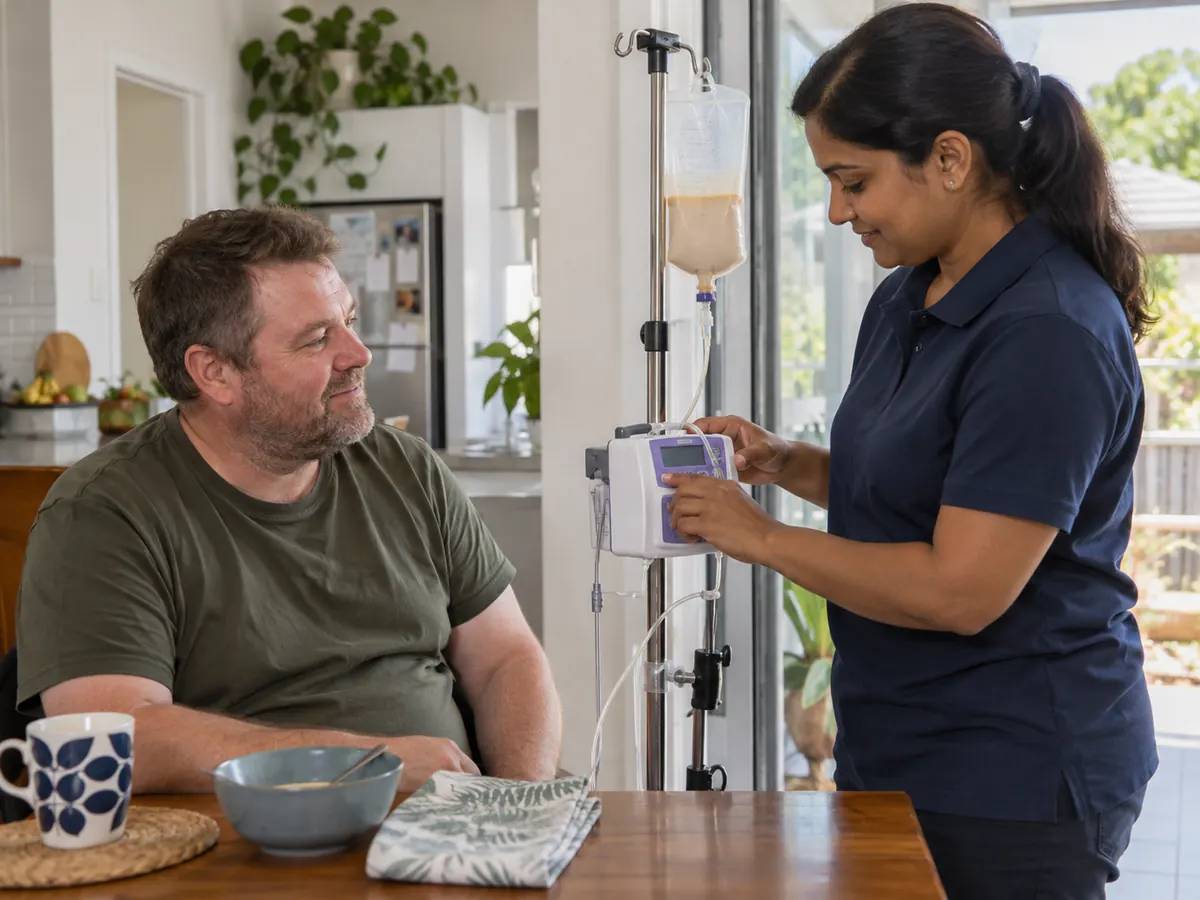
NDIS high intensity supports are a set of eight daily personal activities that carry higher clinical risk: complex bowel care, enteral feeding and management, severe dysphagia management, tracheostomy management, urinary catheter management, ventilator management, subcutaneous injections and complex wound management. That list comes from the NDIS Commission's high intensity supplementary module. A provider has to be registered for this work, and every worker needs training specific to the person they support.
This guide walks through each of the eight, what the Commission expects from providers, how it fits with NDIS funding, and the questions to ask before you agree to anything.
The eight high intensity supports, in plain words
The Commission lists these as high intensity daily personal activities. Here is what each usually means day to day.
- Complex bowel care. Bowel routines that go beyond everyday help, such as a planned program set by a health practitioner.
- Enteral feeding and management. Food, fluids and sometimes medicines given through a tube, for example a PEG.
- Severe dysphagia management. Support for someone with serious swallowing difficulty, usually following a mealtime plan written by a speech pathologist.
- Tracheostomy management. Care of a tracheostomy tube and the airway around it.
- Urinary catheter management. Care of an indwelling or suprapubic catheter, or help with intermittent catheterisation.
- Ventilator management. Support for someone who relies on a ventilator to breathe.
- Subcutaneous injections. Injections given just under the skin, such as some insulin.
- Complex wound management. Wounds that need planned, specialised care, often slow to heal.
If a support is not on this list, the Commission does not treat it as high intensity, however demanding it is. Hoist transfers are a good example. They need training and care, and plenty of participants rely on them every day, but they are not one of the eight. The same goes for stoma care and diabetes support that does not involve injections. Those can still be done well and safely; they just sit outside this registration group.
What the NDIS Commission expects from a provider
To deliver these supports as a registered provider, an organisation must be registered for registration group 0104, high intensity daily personal activities. The Commission says registered providers can only provide the high intensity supports listed on their certificate of registration. So a provider might be approved for enteral feeding and catheter care, and not for ventilator management.
For each of the eight, the Practice Standards set out similar expectations:
- You are involved in assessing your needs and writing your plan for that support.
- With your consent, an appropriately qualified health practitioner reviews your health regularly.
- The plan says how risks, incidents and emergencies will be handled, including when and how to escalate.
- The provider has written policies and a training plan for workers.
- Every worker who supports you has been trained for your particular needs, by a qualified health practitioner or someone who meets the Commission's skills descriptor.
That last point matters most. Generic training on "PEG feeding" is a start. What the standard asks for is training on your tube, your feeding regime and your plan.
Do these supports have to be done by a nurse?
No. The Commission states that it is not a requirement for these supports to be delivered by a nurse or other health practitioner. Trained support workers can deliver them, as long as their training meets the skills descriptor and a qualified practitioner is involved in your plan and reviews.
In practice, the useful question is who trains the workers, who signs off that they are competent, and who they call when something looks wrong at 9pm. A provider with a registered nurse involved in clinical governance can answer those questions from inside the organisation rather than relying on outside help.
Talk to a registered nurse-led team
Call 1300 822 333 or send a referral. We reply to every enquiry within 12 to 24 hours.
Asking a question does not commit you to anything.
How high intensity supports are funded
Funding is decided by the NDIA, not by providers. The NDIS may fund what it calls disability-related health supports when a health condition is caused by your disability. Its list includes dysphagia, continence, wound and pressure care, respiratory care and nutrition, along with expert training for the people who support you. It can also cover items such as dressings or PEG food products.
The NDIS will not fund things the health system provides, such as hospital services, medicines or palliative care. To get these supports into your plan you usually need evidence from your treating health professional.
If a provider tells you they can get your funding approved, be careful. No provider can approve NDIS funding. A good provider can explain what evidence tends to be useful and point you to your support coordinator or my NDIS contact.
Questions to ask a provider before you start
These questions help you tell the difference between a provider that has done this work properly and one that is learning on you.
- Which high intensity supports are listed on your certificate of registration? Can I see it?
- Who will train the workers on my support, and is that training specific to me?
- How do you check a worker is competent before they work alone with me?
- Who reviews my health and my plan, and how often?
- What happens if a worker notices something wrong, such as a blocked tube, signs of infection or a change in breathing?
- Who is on call after hours for clinical questions?
- What happens when my regular worker is sick? Will the replacement be trained on my plan?
- How do you record and report incidents, and will I or my family be told?
- How do I raise a concern, and what if I am not happy with your answer?
A provider should be able to answer these without hesitation. If the answer to the training question is "they all did a course", ask what the course covered and whether anyone has watched them do your care.
Warning signs
Some answers should make you pause.
- They say every worker can do every support, with no mention of individual training.
- They cannot show which supports are on their registration.
- Nobody can name who reviews your plan or who is on call.
- They promise a funding outcome, or offer to "sort out" your plan for you.
You can check any provider's registration on the NDIS Commission's Provider Register. Our checklist for choosing an NDIS provider explains how.
How Trailblazer approaches high intensity support
Trailblazer Community Care is a registered NDIS provider (registration 4050133378) led by Exavier Rikonda, a Registered Nurse with 14 years of nursing experience. Our high intensity and complex care service covers PEG feeding, catheter care, complex wound care and subcutaneous injections, alongside related needs that are not on the official list, such as stoma care and hoist transfers. Our NDIS community nursing team handles clinical tasks that need a nurse.
We don't currently provide severe dysphagia management, tracheostomy management or ventilator management, the other three supports on the Commission's list. If you need any of them, talk to us and we'll help you find a provider who does.
We do not offer support coordination or plan management. If you need either, your existing coordinator stays your contact for funding questions, and we work alongside them. You can read how we manage risk and worker training on our quality and safeguarding page.
Frequently asked questions
What are high intensity supports in the NDIS?
They are eight daily personal activities the NDIS Commission treats as higher risk: complex bowel care, enteral feeding, severe dysphagia management, tracheostomy management, urinary catheter management, ventilator management, subcutaneous injections and complex wound management. Providers must be registered for this work and workers need training specific to each participant.
Is hoist transferring a high intensity support?
No. Hoist transfers are not on the NDIS Commission's list of eight. They still need trained workers and a manual handling plan, and many participants rely on them daily, but they sit with personal care supports rather than the high intensity registration group.
Does a nurse have to provide high intensity support?
Not always. The NDIS Commission says these supports can be delivered by trained support workers, provided training meets the skills descriptor and a qualified health practitioner is involved in planning and review. A nurse is still needed for tasks outside a support worker's scope.
How do I know if a provider is approved for high intensity supports?
Ask to see their certificate of registration, which lists the supports they are approved to deliver. You can also search the NDIS Commission's Provider Register to confirm the provider is currently registered.
Can a provider get high intensity supports added to my plan?
No. Only the NDIA decides what goes in your plan. A provider can explain what evidence is usually helpful, but funding decisions rest with the NDIA. Treat any promise of approval as a warning sign.
- High intensity & complex carePEG feeding, catheter, bowel and wound care by workers trained on your plan and signed off by a registered nurse.
- NDIS community nursingClinical nursing at home for NDIS participants: wound care, continence, diabetes, injections, catheter and stoma care.
- Choosing an NDIS providerHow to check registration, what to ask at the first meeting, and the warning signs to watch for when choosing an NDIS provider.
Talk to a registered nurse-led team
Call 1300 822 333 or send a referral. We reply to every enquiry within 12 to 24 hours.
Asking a question does not commit you to anything.